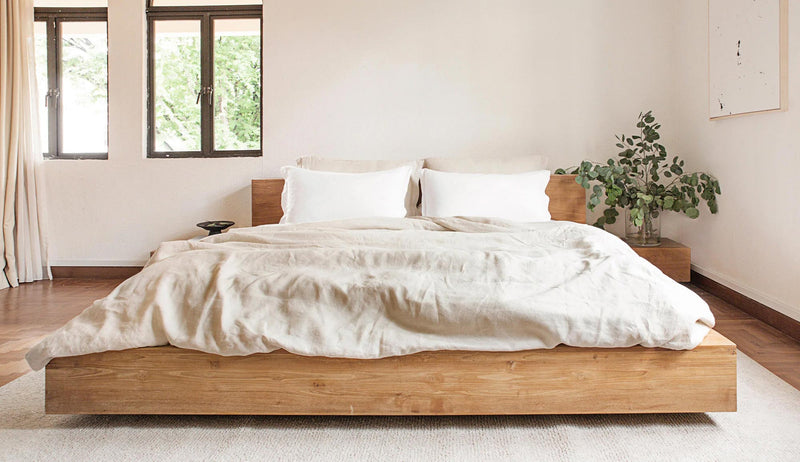
You spend a third of your life in bed. The fabric against your skin how it breathes, what it's made from, and where it came from matters more than most bedding brands acknowledge. Linen has been trusted in bedding for thousands of years. But "linen" as a label tells you little on its own. It can refer to fabric grown and processed almost anywhere in the world, under vastly different conditions, with no reliable quality floor.
European flax linen is different. It's a certified, traceable category of linen that carries independently verified guarantees about origin, environmental standards, and material quality. Here's what those guarantees mean and why they matter.
Quick Overview
- Linen is made from the fibres of the flax plant; European flax refers to flax grown in Western Europe, primarily France, Belgium, and the Netherlands
- The European Flax certification is issued by the Alliance for European Flax-Linen and Hemp and guarantees origin, traceability, and environmental standards
- The process is significantly more labour-intensive than cotton production, which is reflected in linen’s higher price point.
What is Flax Linen?
Linen is derived from the long bast fibres found in the stem of the flax plant (Linum usitatissimum). After harvesting, the stalks undergo a process called retting where the plant material is broken down to loosen the fibres followed by scutching and hackling to extract and refine the usable fibre. These fibres are then spun into yarn and woven into fabric. The process is significantly more labour-intensive than cotton production, which is reflected in linen's higher price point. Well-maintained linen bedding can last 15 years or more, significantly longer than most cotton bedding.

What that process produces, however, is a fabric with a genuinely exceptional set of properties. Linen is strong, highly breathable, moisture-wicking, and remarkably durable.
What Makes European Flax Different?
The regions of Normandy and Hauts-de-France in northern France, along with parts of Belgium and the Netherlands, have a climate that is uniquely suited to high-quality flax cultivation. Mild temperatures, consistent natural rainfall, and specific soil composition allow flax to reach full maturity without artificial irrigation or chemical assistance. This is not a universal condition in other flax-growing regions, irrigation and pesticide use can be substantial.
European flax is one of the most resource-efficient crops in textile production. The long fibres go into textiles. The short fibres go into paper and composite materials. The seeds are pressed for linseed oil. The roots are left in the ground to biodegrade naturally, enriching the soil for the following season. Nothing is discarded.
At field level, the environmental case is compelling. According to the Alliance for European Flax-Linen and Hemp, European flax fields collectively capture an estimated 276,000 tonnes of CO₂ annually meaning that the cultivation phase of linen production is effectively carbon negative. This figure covers field-level carbon capture only, not downstream processing or transport. As a raw material at the cultivation stage, European flax has one of the most favourable environmental footprints of any textile fibre.
What Does the European Flax Certification Mean?

The European Flax certification is an internationally registered trademark issued by the Alliance for European Flax-Linen and Hemp. It is now formally transitioning to sit alongside the Masters of FLAX FIBRE mark. Critically, it is not a self-declaration. It is verified by independent third-party auditors with no commercial relationship to the brands using it.
To carry the certification, a product must contain flax fibre that was grown and processed exclusively in Western Europe. The certification provides verified traceability from field to fibre meaning the entire upstream supply chain, from the farms where the flax is grown to the scutching mills where the fibres are extracted, is audited and documented. Both the European Flax and Masters of FLAX FIBRE marks are currently in use; if you see either on a product, they indicate the same independently verified standard.
Many European flax linen products also carry Oeko-Tex Standard 100 certification, which addresses the downstream half of the supply chain. Where European Flax certification covers origin and fibre traceability, Oeko-Tex Standard 100 verifies that the finished woven product including any dyes, finishing treatments, or processing chemicals has been tested and confirmed free from harmful substances at every stage. Together, the two certifications cover the full journey from field to finished product.
European Flax Linen vs. Generic Linen vs. Cotton: A Direct Comparison
|
|
European Flax Linen |
Generic Linen |
Cotton |
|
Origin verified |
Yes certified |
No |
Varies |
|
Grown without pesticides |
Yes |
Not guaranteed |
Not unless organic |
|
Irrigation required |
No |
Often yes |
Yes, significantly |
|
Breathability |
Excellent |
Moderate to good |
Good |
|
Moisture wicking |
Excellent |
Moderate |
Moderate |
|
Softens over time |
Yes |
Varies |
Minimal improvement; may degrade with repeated washing |
|
Typical lifespan |
15+ years |
5-10 years |
5–8 years (varies by quality) |
|
Carbon footprint (cultivation) |
Carbon negative at field level |
Higher |
High (water-intensive) |
|
Third-party certification available |
Yes (European Flax / Oeko-Tex) |
Rarely |
Yes (GOTS / Oeko-Tex) |
How European Flax Linen Performs as Bedding
European flax linen's sleep performance stands out across every relevant metric. It is highly breathable and naturally temperature-regulating, keeping you cooler in warm weather and providing gentle insulation in cooler months. This makes it a practical year-round bedding material across most climates, and for sleepers in humid climates like Singapore, where moisture management during sleep matters significantly.

Linen's moisture-wicking performance makes it one of the most effective bedding fabrics available. It draws moisture away from the body and releases it quickly, rather than holding it against the skin the way synthetic fabrics or lower-quality cotton does. For people who sleep warm, this difference is noticeable from the first night.
Linen is also naturally resistant to bacteria and mould, and its low-allergen properties make it ideal for sensitive skin and respiratory allergies. And unlike virtually every other bedding fabric, linen improves with use. Linen softens noticeably over the first years of use, with each wash improving its feel. A set of quality linen sheets purchased today will be noticeably more comfortable in two years and still performing well in fifteen.
Discover Heveya's Linen Sheets
Quality European flax linen costs more upfront than conventional bedding but at a cost-per-year over a 15-year lifespan, it's often the more economical choice. Heveya's European flax linen sheets are made from certified flax, independently verified from field to fibre, and designed to work alongside Heveya's natural latex mattresses as part of a consistently chemical-free sleep environment. If you're ready to experience the difference certified linen makes, explore the full range online or speak with a consultant at your nearest Heveya showroom.